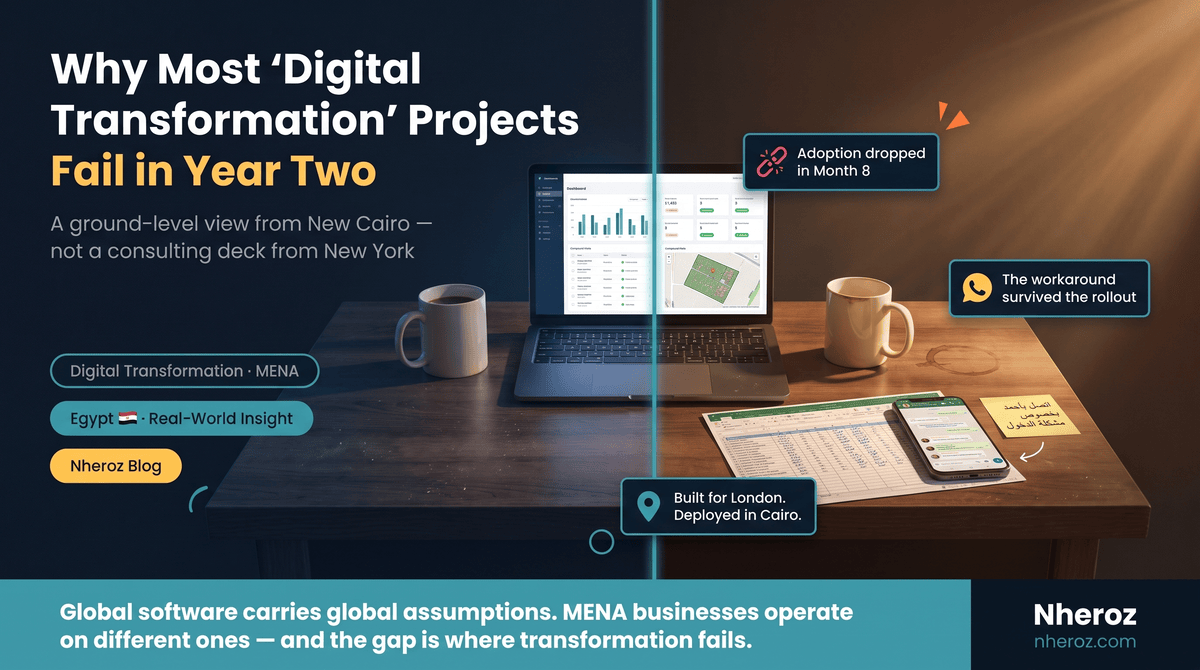
You know exactly how this goes. The system was purchased. The consultant was hired. There was a launch meeting, maybe even a small celebration. And then — quietly, over the following twelve months — the old Excel file came back. The WhatsApp group never actually stopped. The software is still technically running, but the only time anyone opens it is to pull a report before a board meeting.
If you've been through this, I'm not here to tell you what went wrong at the 30,000-foot level. I'm here to tell you what I've watched go wrong on the ground, in Egypt and across the region, repeatedly.
The Global Playbook Was Not Written for Us
Most digital transformation frameworks were developed by and for Western enterprises. They assume reliable broadband, a workforce that grew up navigating SaaS tools, established card-based payment infrastructure, and an organizational culture where employees trust new systems rather than fear them.
That is not the baseline in Egypt. That is not the baseline across much of MENA. And a framework built on assumptions that don't exist here will fail here — not because your team isn't capable, but because the operational reality is entirely different.
"A system designed for a London office doesn't survive in a New Cairo compound. Not because the people are less capable — but because the operational reality is entirely different."
This is the gap where transformation fails. And until we name it honestly, we keep buying the same systems and getting the same results.
The Four Patterns I Keep Seeing
Pattern 1: The system was built for the boardroom, not the building. The transformation decision is made at the executive level — which makes sense. But the people interacting with the system every day are operations staff, security, building managers, field technicians. If those users find the system adds friction to an already demanding day, they won't use it. They'll do what they've always done. The platform becomes a reporting layer executives trust while the actual work happens elsewhere.
Pattern 2: Arabic UX was an afterthought. Offering an Arabic option is not the same as building for Arabic. Many platforms take an English-first interface and drop RTL text into it. The result feels broken — clipped labels, misaligned buttons, a reading flow that fights the layout. Users notice. A poorly adapted Arabic interface signals, without a single word, that this product was not built for them.
Pattern 3: The software assumed internet that doesn't exist. A security officer in a large compound, a warehouse manager in an industrial zone, a field rep on the move — these users may be working on 3G at best. If a system requires fast connectivity to function, it will be blamed for being broken. Egyptian user tolerance for slow software is genuinely low. One loading spinner is a test. Two is a reason to go back to WhatsApp.
Pattern 4: The payment flow broke trust. Many platforms assume users will pay by card, accept automated debits, or trust an online checkout flow without hesitation. The Egyptian market reality is that a significant portion of transactions are still cash-adjacent. Trust is built through document confirmation and human verification — not automated processing. A payment system that ignores this doesn't get adopted. It creates friction, disputes, and eventually gets abandoned.
What Building for This Market Actually Looks Like
VatrinaView — our live SaaS platform serving 50+ paying customers — was built on a direct observation: Egyptian small traders sell on WhatsApp first. They take orders through DMs, confirm by voice, and collect payment in person or via InstaPay. We didn't design against that behavior. We designed around it.
The InstaPay integration works through document upload and seller confirmation — not automated card processing — because that matches the trust model Egyptian buyers already operate within. The three-tier image storage system (200×200 thumbnails, 600×600 standard, 1200×1200 zoom) was a direct response to Egyptian internet speeds, not a generic optimization borrowed from a global playbook. Traders use it because it feels like it understands their market. You can see it live at drmobile.vatrinaview.com.
With CammPass — our compound management system currently in development — we're applying the same logic to the real estate sector. The resident-facing layer is the primary design direction: announcements, maintenance requests, community governance, digital ticketing. That's where trust is built. The security integration is being designed around the access control hardware Egyptian compounds actually use — not a theoretical global standard. And the Arabic interface is not a translation. It is the starting point.
We didn't design CammPass for a European real estate market and adapt it for Egypt. We designed it from the ground up for the Egyptian compound experience.
Before You Sign Any Digital Transformation Contract in MENA — Ask These Five Questions
- Has this system been deployed in an Arabic-first environment before — not translated, but designed for Arabic from the start?
- Does the system function on 3G or variable connectivity, or does it require broadband to perform?
- Were frontline users — not just managers — involved in the design process?
- How does the payment and verification flow handle cash-adjacent transactions?
- Can the vendor show you a MENA deployment — not a global case study?
If the answers are vague, the system was not built for your context.
At Nheroz, we don't build software for an imaginary average user. We build it for the specific business, in the specific market, with the specific infrastructure that actually exists. That's not a philosophy — it's the difference between a system people use and one they don't.
If you're planning a digital transformation project in Egypt or the MENA region and want a partner who understands the ground-level reality, I'd like to talk. Book a free 30-minute strategy session →