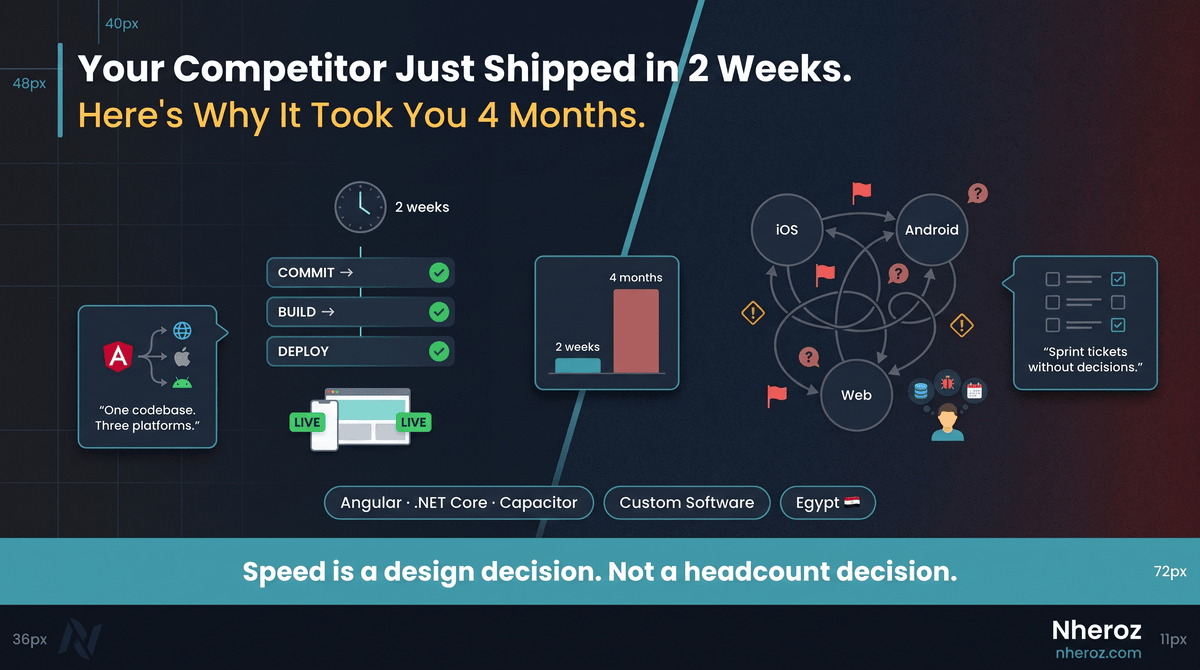
It's Sunday night. You open LinkedIn and see it — your competitor just announced a feature you've had on your roadmap for three months. Your team is talented. The tickets exist. The roadmap is real. So why are they faster?
I've watched this moment happen to founders more times than I can count. And almost every time, the instinct is the same: we need more developers. That instinct is wrong — and acting on it often makes things worse.
The bottleneck isn't motivation. It's structure. Here are the four structural reasons your team is shipping slowly.
1. You're Rebuilding the Same Thing in Three Different Places
Many companies build a web app, then a separate iOS app, then a separate Android app. Three codebases. Three teams. Three sets of bugs to fix, three deployment pipelines to maintain.
Every new feature now requires three times the work. Every bug fix has to be applied three times. Every designer review happens three times. This isn't agility — it's structural debt that compounds with every sprint.
At Nheroz, we chose Capacitor specifically to avoid this. One Angular codebase. Web, iOS, and Android from a single source. Three platforms, one team, one deployment cycle. I want to be clear: we didn't choose Capacitor because it's the only option. We chose it because it matches the team size and cost model of the companies we build for — where running three parallel development tracks simply isn't viable.
2. The Architecture Wasn't Designed for Change
When every new feature requires touching seven different files and three database tables, the codebase is fighting you. This is what "technical debt" actually looks like in practice — not a theoretical problem, but a tax on every single sprint.
Each change costs more than the last one, because the system was never designed to evolve. A well-architected system lets you add a new module without breaking existing ones. Most fast-shipping teams design for this explicitly from day one — before a single feature is built.
3. Decisions Are Being Made During Development, Not Before It
Every time a developer has to stop and ask "should this button appear for all users or only admins?" — the sprint slows down. That isn't a technical question. It's a product question. And it should have been answered before the ticket was assigned.
Velocity isn't a code problem. It's a clarity problem. Teams ship fast when every ticket contains a decision, not a question waiting to be resolved mid-sprint.
4. QA and Deployment Are Still Manual
If testing means a human clicking through 40 screens before every release, you will ship monthly at best. Automated testing and CI/CD pipelines aren't luxury infrastructure reserved for large engineering teams — they're the foundation that lets small teams ship fast and confidently.
You cannot ship every two weeks if deploying takes two days and breaks production every third time.
Speed Is a Design Decision — Not a Headcount Decision
Hiring more developers does not automatically make a team faster. Adding people to a slow team often makes it slower — more coordination overhead, more merge conflicts, more misalignment on what "done" means.
The teams that ship fast made a set of deliberate choices early. They picked a technology stack they could own deeply, not the trendiest one. They designed architecture to be modular before writing feature code. They defined acceptance criteria for every ticket before the sprint started. They automated the repetitive parts.
Every choice in the Nheroz stack was made to reduce the number of decisions required during development — so the team spends energy on the product, not the infrastructure:
- Angular — one framework across web and mobile UI. The team builds expertise in one place, not three.
- .NET Core — proven, performant, cross-platform backend. No surprises at scale.
- Capacitor — web-first mobile. One deployment covers iOS, Android, and web simultaneously.
- PostgreSQL / SQL Server — reliable, structured data for transactional systems. No experimenting at the database layer.
What This Looks Like in Practice — VatrinaView
VatrinaView is a live SaaS product we run with 50+ paying customers, accessible at drmobile.vatrinaview.com. It supports web and mobile from a single codebase using Capacitor. When we ship a feature, it goes live on both platforms in the same sprint — not in separate quarters.
The three-tier image caching system — thumbnail, regular, and full zoom — was built once and applies to every merchant store on the platform. The account-based multi-tenancy model means onboarding a new store requires zero architectural changes. It was designed in from day one.
The velocity of VatrinaView isn't because we have a large team. It's because the architecture was designed so a lean team could move fast without breaking things.
5 Questions to Diagnose Why Your Team Ships Slowly
- How many separate codebases do you maintain for the same product?
- When was the last time a feature was added without touching existing functionality?
- What percentage of your sprint tickets have clear acceptance criteria before they're assigned?
- How long does a typical deployment take from code-complete to live?
- How many developer hours per week go to fixing bugs in existing features versus building new ones?
If those questions made you uncomfortable, the bottleneck is structural — not motivational.
Your competitor isn't faster because they have better developers. They're faster because at some point, someone made a set of deliberate decisions about how their system should be built. That decision is still available to you.
If you want to walk through your current setup and identify where the slowdowns are actually coming from, I offer free 30-minute sessions to do exactly that. No pitch — just a clear-eyed look at the structure. Book a session here →